Welcome to April’s Poetic Voice. Yes April! You won’t find any fools here though. You will find this month’s incredible poet.
I first encountered them on social media, responding to the same prompts as me. I was impressed by their language and their subject matter. It was at a couple of open mics I first heard their moth poems…
And this month’s feature is jam-packed. Not only do we have a selection of poems including pieces from their new pamphlet releasing in April but also an interview…
Without further ado, this month’s Poetic Voice is Eleanor Holmes.
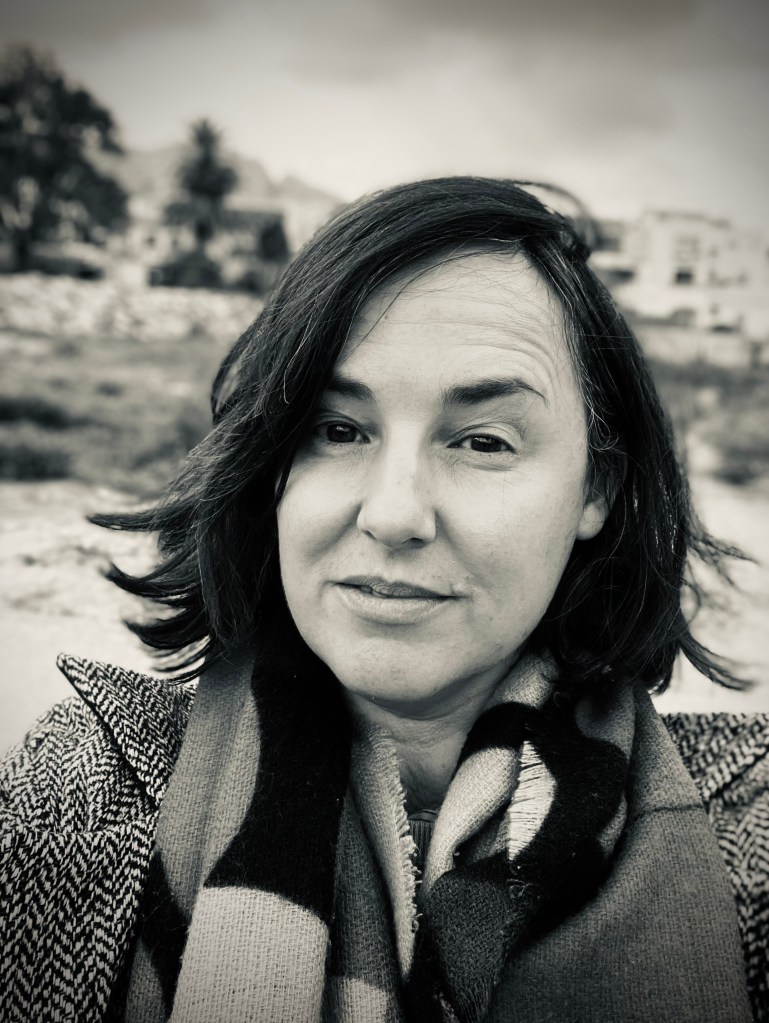
Eleanor Holmes (previously writing as Eliot North) is a neurodivergent mother-doctor-writer of prose, poetry and hybrid. Originally from Bristol in the UK, she has spent her life exploring different cultures and countries, loves to collaborate with other creatives and has a life-long obsession with illustration, printmaking and beautiful handmade books. She lives with her son and husband in Valencian Country, Spain, and works as an NHS GP in Weston-super-mare. Widely published in print and on-line, she was commended in the National Poetry Competition 2014 and shortlisted for the Bridport Poetry Prize 2025. #Moth is her first hybrid collection.
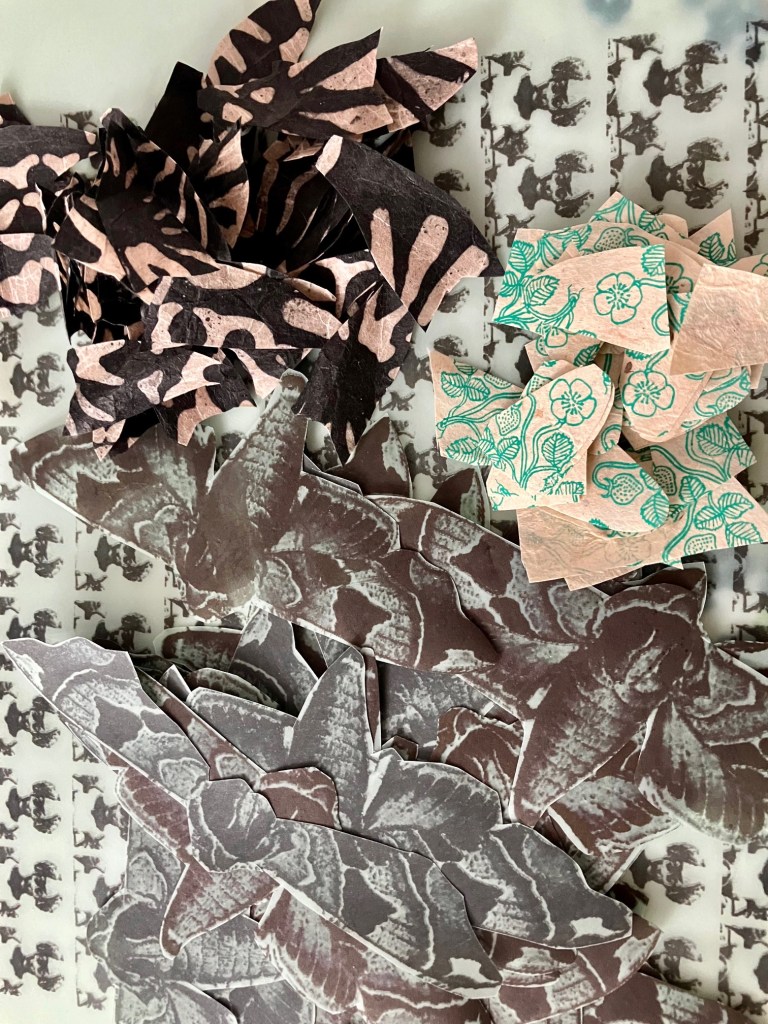
For the first part of the feature, we have a piece from #Moth, which can be ordered from Ethel Zine here. The books are handmade and have an incredible quality to them as you can see from some of the images below. A massive round of applause for Ethel for the amount of effort they make in their publications.
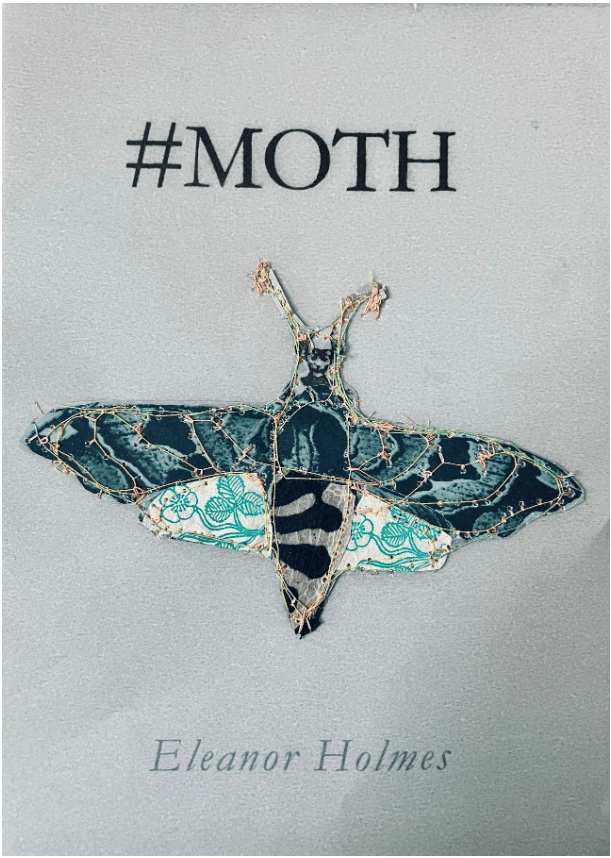
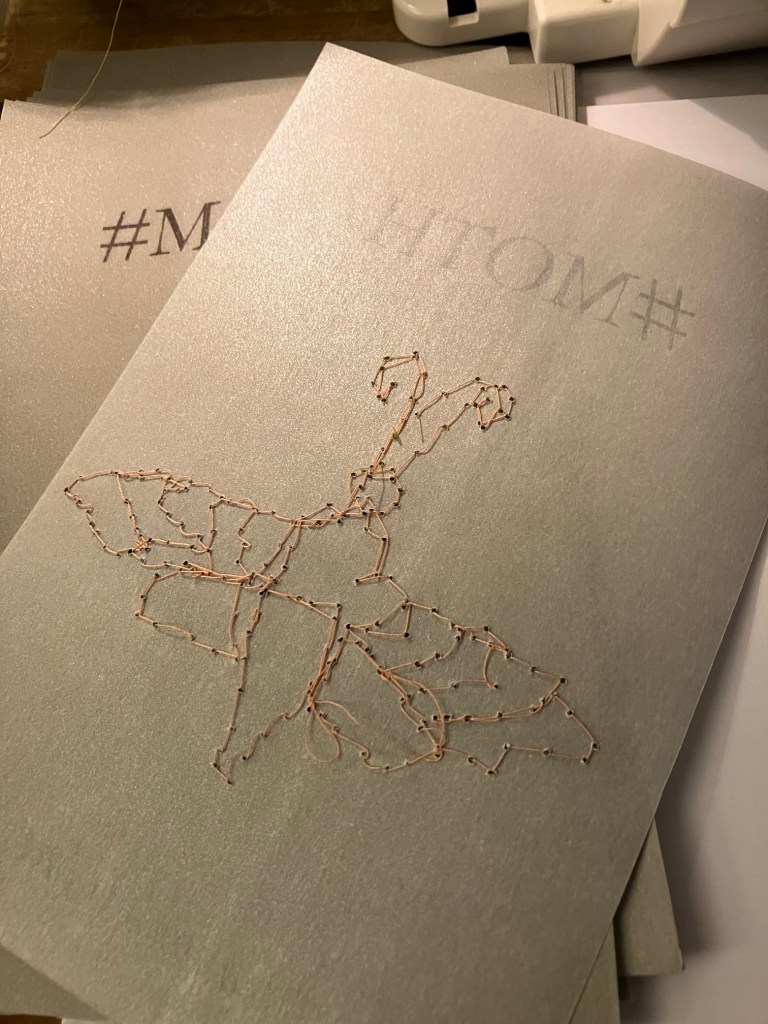
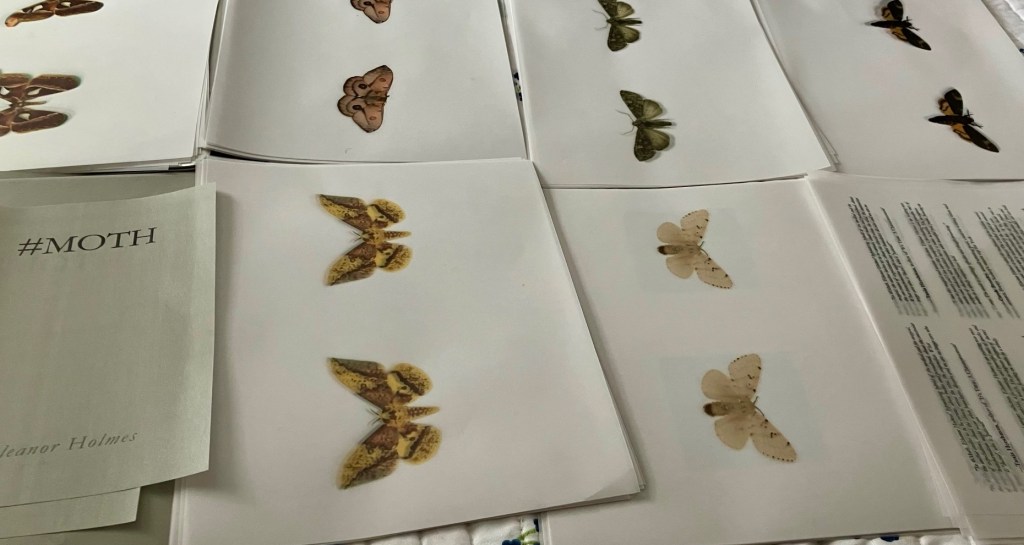
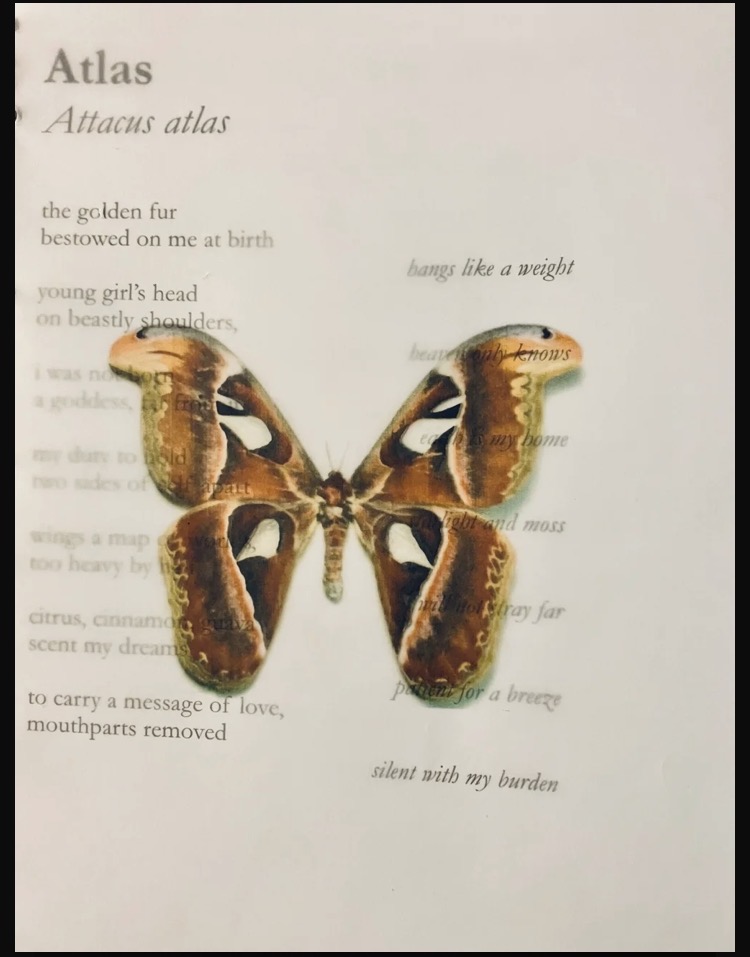
Eleanor has also treated us to a recording of ‘Trap’, one of the poems from the collection which is accompanied by harp. Listen here.
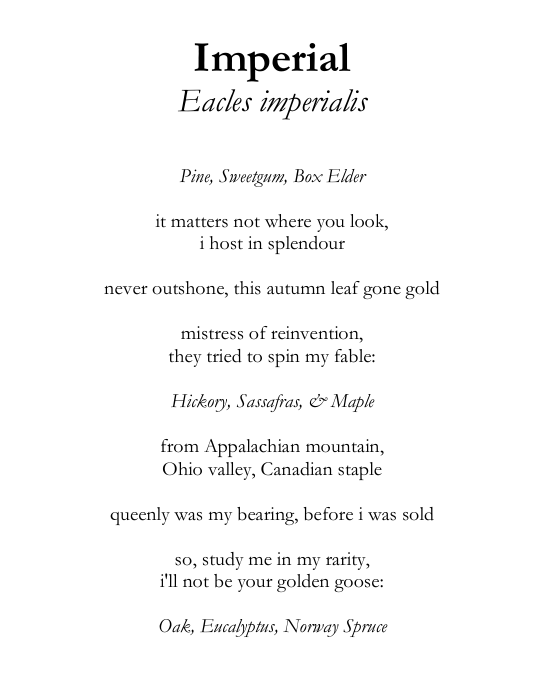
This brings me to Eleanor’s first poem. Imperial. This is one of my favourites from the collection for its multi-sensory feel.
A Few Questions and Answers from Eleanor on her Writing Process
PS: Eleanor, what was the inspiration for #Moth?
EH: #Moth started life in a Tania Hershman workshop ‘Hybrid Writing: Unbox Your Words’ back in 2021. The whole course was focused on ‘hybridity’ in terms of theme as well as form.
Tania had us coming up with all sorts of ‘Chimera-like’ ideas, using scientific text exploring genetics and chimerism as inspiration, as well as myth and imagination. The idea for my main character ‘Vadoma’, a moth-woman hybrid, came from this start. Many of the poems in #Moth weave the natural history of moths with the personal narrative of my main character, with a sprinkling of magic realism.
Tania’s hybrid writing technique or ‘mash-up’ approach to different writing styles resonated with me. Taking scientific texts, adverts, images, shopping lists, fairytales, procedurals, forms (anything goes) and mash it, cut it up, splice it with something else entirely. I don’t like to be pigeon holed, in life and in my writing, and this approach made sense to my neurodivergent brain.
I’ve been both fascinated, and equally dismayed, by the language of medicine over the years. When I studied psychiatry as a student, terms like ‘word salad’, ‘knights move thinking’ and ‘flight of ideas’ that are used to describe formal thought disorder really got my brain humming. The idea of ‘punning and rhyming’, ‘pressure of speech’, use of ‘neologisms’ being a sign of mania or psychosis, and that looking for these formed part of the traditional Mental State Examination (MSE), really intrigued me as I thought to myself: these are all things I have experienced to some extent, they form the basis of so much creativity, performance, poetry particularly.
In saying this I don’t wish to minimise the impact of serious mental illness. I believe good psychiatric care and mental health service provision saves lives. It is more an observation that in medicine the ‘them and us’ narrative serves no one.
In writing #Moth I aimed to take the language of medicine apart; examine it and twist it to shine new light on it. I wanted to explore: ‘what is normal’ and examine the power imbalance inherent in the way medicine operates, and then I wanted to try and flip the narrative. Tania’s course provided me with both the inspiration and the hybrid writing techniques to start this process.
PS: What does your writing process typically look like?
EH: I call myself a ‘magpie writer,’ my brain is constantly looking for the next shiny thing to latch on to. Scraps of speech, my son and I walking to school is a fabulous source of material just now: a six-year-old’s imagination knows no bounds and veers between the delightfully surreal and completely matter of fact.
This chatter with my son and observing my surroundings, little things glimpsed in the everyday, like a cormorant gliding by on my walk home, or a pearlescent piece of shell on a beach keeps my creative brain buzzing. Living in Valencian Country in Spain, where my husband is from and my son was born, is a gift for a writer noticing the ‘unusual’ in my surroundings, immersed in a different culture, language and landscape. This combined with the endless mine of creative material that is my memory, especially of childhood, means the ideas never stop coming. Pinning them down, crafting them, that’s the tricky part.
I make notes on my phone when I’m walking, or when I get home, or before I go to sleep. I collect scraps of things and then try and make sense of them as a whole, stitching words together, moulding them into something new. There never is a ‘this is a poem’ or ‘prose piece’ in the way I approach writing these days, it tends to just come out like a block of text or stream of consciousness. Form, or thinking about form, tends to come later in the process, when I’m trying to make sense of what material I’ve got. That said, I wrote a sestina recently in a Kim Moore and Clare Shaw workshop, and it led me somewhere unexpected which was fun.
I’ve always been an outsider, as a child I was pretty much mute and always observing. I learned to mask this, to function ‘better’ in a world that expected more from me. In medicine I was definitely an outsider as well, but I found my tribe of other ‘odd ball’ creative medics along the way. It is only in perimenopause, and as a woman who gave birth later in life, that I’ve realised how much of the way my brain works and my inherent need to create, is linked to my own neurodivergent thinking.
PS: Your background is in medicine which requires a use of clinical language, how do you arrange the precise clinical language versus the poetical in your mind when crafting your work?
EH: This is a really interesting question, because often I don’t think my clinical language is precise. It clearly is in some ways, has to be, in that there is an expected way that clinicians communicate with each other and diagnosis at its core is based on communication and taking a ‘history’.
The whole language of western medicine, the historical context and assumptions, all the inherent problems I just discussed above are stitched into the way we communicate as clinicians. We learn this language from day one at medical school, and I’ve often said as a medical educator, through this process we almost teach students to become worse communicators as a result. A situation that then means you can spend your whole career attempting to undo that learned reductive way of thinking and speaking (or not, depending on the clinician!)
Now as an adult, living in a country where my mother tongue of English is not the spoken language of the day to day, I am learning first-hand how hard this is to navigate. The jumble in my brain is often utterly exhausting and many times my ability to communicate totally falls apart. Add to this my husband’s mother tongue is Valencian (Catalan) and I’m trying to learn Castilian (Spanish) at the same time, then all sorts of scales have fallen from my eyes, particularly about the privilege attached to being a white, native English speaker (but also the lack that being monolingual inherently represents.)
For me language, and so poetry, is playful. In my communication with patients as a GP, I have to actively check my use of ‘medical language’ or jargon when I’m speaking to people, these days mostly on the phone working remotely from Spain. This isn’t that hard to do these days; I find communicating with patients a real joy when I can match or mirror language used and explore shared experience and common ground. Creating connection and trust is one of the most, if not the most, important thing in my medical practice. Without it, I wouldn’t be able to achieve anything as a doctor, well nothing positive anyway.
So, to actually answer your question, I don’t think my clinical language is precise, or that my poetic language is not precise. In some ways maybe it’s the reverse? The two are inseparable. I find the poetic in medicine, because people are messy and endlessly surprising. Poetry is precise, condensed, intentional; much more so in some ways than my clinical language which has become like driving a car, or shorthand. Creative writing for me breathes life into my learned medical language, it allows me to play with it, see the possibilities outside the clinical, then hone and hone and hone to become something else entirely.
Words matter way more than we are given to believe at medical school. Poetry, amongst other things, has helped me to see this more clearly.
PS: What piece of advice would you give to poets?
EH: I would say don’t be too hung up on writing ‘poetry’, just write. That first outpouring on the page, and the flow state I find with creating anything, is such an absolute pleasure and catharsis for my busy brain. It doesn’t have to go further than this, but also it can!
There are many ways to approach poetry and creative writing, and there is as with any creative process, a craft to be learned. My advice, as so many have said before, is read, and read a lot! Read for pleasure but also start to take note and pull apart what someone is doing when you really connect with their work. This has helped me enormously to start to pay attention to what a writer is doing in a text and then thinking ‘how did they achieve this?’
For me attending lots of workshops with great writers I admire has helped loads and broadened my reading and introduced me to new writers and creatives. This doesn’t need to cost a lot, and on-line works really well for me in terms of flexibility around family life (see January Writing Hour with Clare Shaw and Kim Moore.)
Connecting to poetry communities on social media like #poemsabout and #promptcombo on Bluesky and @TopTweetTuesday on X is also a great way to write more and receive feedback.
Reading your work aloud at open mics (see Paul’s excellent Book Bag open mic), connecting with other writers and building a trusted group of fellow creatives you can share your work with, and expect and give honest and supportive feedback to, has been essential for my development as a writer.
This and approaching established writers whose work you love for mentorship – big shoutout to Carole Bromley and Rebecca Goss – who have both helped my craft and confidence enormously in the last year.
PS: Finally, after reading #Moth, who else should people be checking out?
EH: If you like the hybrid nature of this book, then Tania Hershman is ‘The Queen of Hybrid’ and her latest book ‘Time: a Cronomemoir’ is out with Guillemot Press. The serialised audio of this on Tania’s Substack is ace, as well as her back catalogue of work on her website. Tania is a huge inspiration and a really fab workshop facilitator as well. https://taniahershman.com
I have become a bit of a fan girl of Nina Mingya Powles. How her writing spans all forms and genres and embraces hybrid. I would start with her marvellous ‘non-fiction’ essay writing. Being a foodie, I especially loved ‘Tiny Moons’ with The Emma Press, as well as her latest collection of poetry ‘In The Hollow of The Wave’ with Nine Arches Press. Her blog Crispy Noodles is ace and always makes me marvel at her writing as well as making me hungry. https://ninamingya.substack.com
I love any writer who embraces play and was alerted to Jon Stone and the concept of ‘Ludokinetic Poetry’ when he wrote a Poetry Society piece for National Poetry Day on a poem I wrote years ago called ‘The Crab Man.’ Jon’s website is a rabbit hole of invention that I could happily spend hours exploring. https://www.gojonstonego.com
Definitely check out Elizabeth Osmond‘s forthcoming debut poetry collection ‘Hatchery’ coming out with ‘V. Press’ late this year: a magical weaving of Beth’s neonatology consultant background, the history of this medical discipline, as well as the realities, joys and heartbreak of working in care and the NHS. This is a poetry pamphlet not to be missed! @bethosmond.bsky.social
For sheer artistic brilliance check out Sarah Raybould whose work spans filmpoetry, musical composition, performance, spoken word, visual art, dance and hybridity of all kinds. Sarah’s latest filmpoetry compositions with ‘IceFloe Press’ and ‘Ink, Sweat & Tears’ are stunning. She will also feature in Black Bough’s Silver Branch Series soon, so don’t miss that. @raybould_drs on X
I could go on, there are so many fab writers out there on social media, on-line and in print publishing, as well a whole host of fabulous independent presses, of which Ethel Zine is one that I particularly admire. Those writers mentioned above are all quite different, and a mere toe-dip into the pool of poetic creativity I see around me.
The next poem lands on 11th April. Another of my favourites from #Moth. Remember to bookmark this post.
If you’d like to attend the #Moth online launch, click here for full details and to grab your free ticket.
In the meantime, stay poetic.
Paul
 Paul Writes Poems