Welcome to August’s Poetic Voice, a poet who I have had the pleasure of meeting in Wales, once upon a time in Neath. They are somebody whose work is always full of soul and energy, often associated with deep time, and I have been lucky to write a small blurb for their recently released book with Black Bough Poetry. They are an exceptional writer and an even more exceptional person.
Without further ado, I’m thrilled to announce the Poetic Voice for August 2026 is the tremendous Polly Oliver.
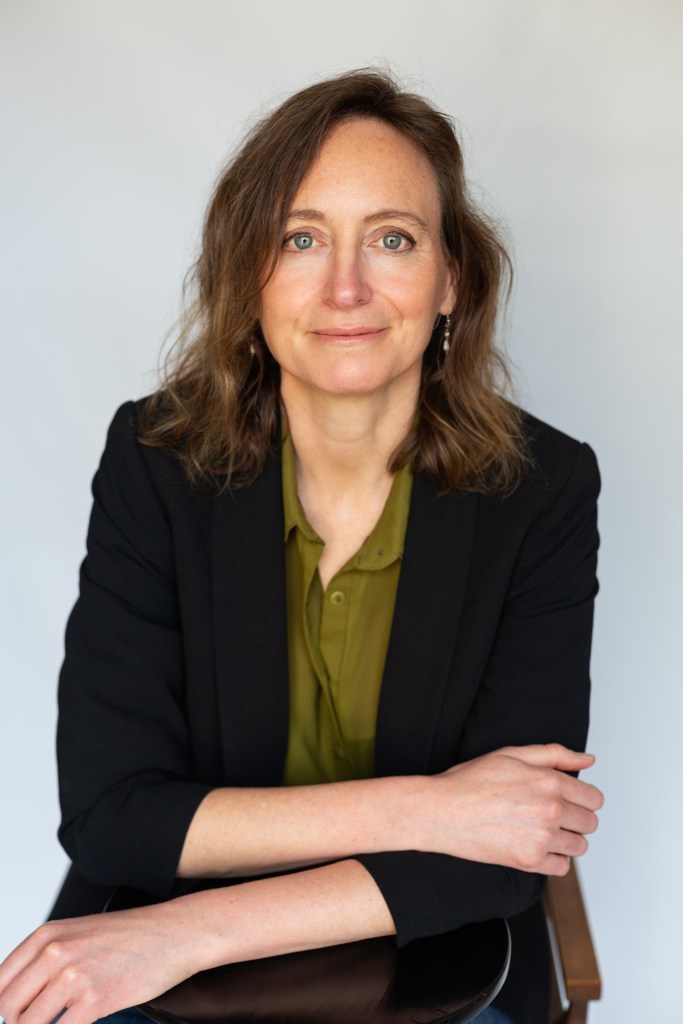
Polly Oliver (she, her) is a writer based near Mumbles in Wales where she lives with her husband and two teenage sons. Although born and bred in Cornwall, she has some roots in Wales and has lived there since she studied literature and cultural theory at Cardiff University at the tail end of the 90s. She is learning Welsh and could never live far from the sea.
Polly has been writing poetry since discovering the poetry community on social media and attending local open mics.
Polly has had a career in radio news and communications, and is inspired by other people’s stories, legends in landscape and coast, and geological and personal time.
Polly is sharing work from her book Edges of Our Days, published by Black Bough Poetry (2026) available to buy here . Polly has also been kind to do a small Q & A to give some insight into her inspirations behind her writing. If you’d like to attend the live launch of Polly’s collection, it is taking place in Mumbles on 8th August at Harry’s Bar. Check Black Bough Poetry on social media for more information.
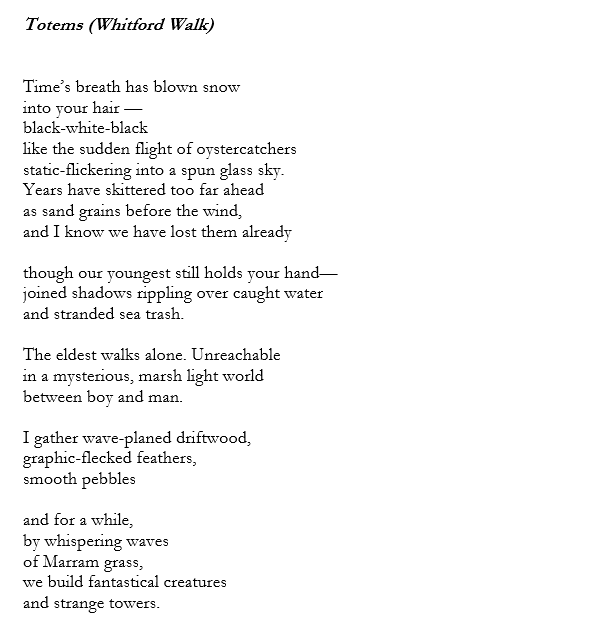
The first piece from Polly is a blend of myth and place which delivers a real sense of presence.
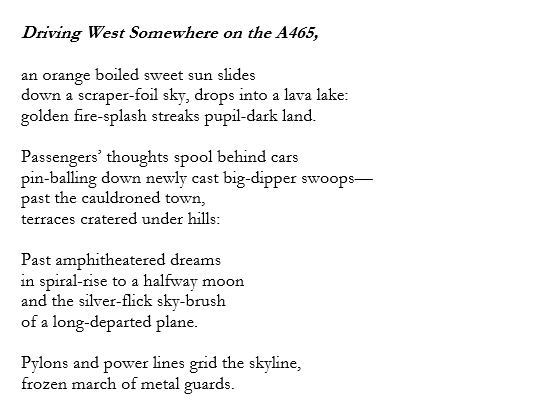
The next poem has a companion piece in Polly’s collection. It deals with the shifting landscapes as travellers move across Wales into England and the stories they offer.
More poems will be shared on 15th August, why not take time to read the below Q & A to learn more on Polly and her inspiration and some tips.
PS: A nice, easy one to begin. Who are your poetic influences?
PO: In spite of doing an English Literature degree at Cardiff with Creative Writing modules, I have to be honest here and say couldn’t really say that any of the poetry content made me sit down and read or write poetry when I was in my teens and 20s.
At that age the faint hint of cringe hung about my early efforts which I was churning out to meet deadlines rather than being genuinely invested, and reading out our work to the group half-killed me with shame! Back then poetry just felt a bit like an annoyingly oblique way of getting things across! It kind of followed that I became a journalist straight afterwards, and “show don’t tell” was not going to work in a two-minute radio bulletin.
In fact, I think the poetry that was more influential on the way that I thought, saw or heard the poetic was the stuff I encountered in earlier childhood. I have written elsewhere about how in a pre-YouTube world the books and their illustrations that surrounded us as kids were more impactful on our psyche than they perhaps might be in an era when multiple creative forms and media such as gaming, short form social media content, and vastly more film and TV options are available to young minds. Not to mention the possibilities thrown up by AI.
In early childhood there were one or two poems that stuck. I remember an anthology we had with beautiful illustrations called Time’s Delights. Looking back, it was probably all very white and canonical, but it included “To a fat lady seen from the train” by Frances Cornford. Its strange sensual details, indefinable emotion and discomfiting repetition stuck with me:
O why do you walk through the fields in gloves,
Missing so much and so much?
O fat white woman whom nobody loves,
Why do you walk through the fields in gloves,
When the grass is soft as the breast of doves
And shivering sweet to the touch?
O why do you walk through the fields in gloves,
Missing so much and so much?
The anthology also included “Fog” by Carl Sandberg, and I was haunted by the “little cat feet”; so deft, so striking.
On the subject of haunting, I loved Walter de la Mare’s “The Listeners” too and I still try and bring the unsettling, otherworldly and unanswered into some of my poems. The story which leaves more questions and a sense of something darker!
I honestly can’t remember when or why the switch flicked and I started writing poems. Motherhood perhaps? Or something dreadful like love! Anyhow, it was a while before I took the plunge and started going to local Swansea open mics such as Howl, Talisman and the brilliantly raw-edged, hilarious and sometimes heartbreaking Drunk Poets Society in Port Talbot.
Hearing poems and spoken word aloud is so important to developing the musicality of your own work, especially in Wales where the expressive turn of phrase is everywhere and the real language of Wales is pure music.
That was how encountered Matthew M.C Smith whose cosmic and geological vision and powerfully original images made his themes of memory, landscape, longing and time -themes that I am also drawn to – hum.
Then there was the pandemic, and Skype, Zoom etc exploded into default usage, allowing poets from opposite sides of the globe to read live to one another. Magical in a way.
Via Matthew and Black Bough initially, I tuned into a warm, welcoming and incredibly inspiring online poetry community, largely based on Twitter, but now I’m really only on Instagram (only for reasons of keeping things together instead of being scattered). Social media levels the playing fields and opens doors for poets who may find it hard to access traditional ways of developing their voice and style. There are so many poets out there now, producing amazing work and more importantly cheering each other on.
PS: How would you describe your poetry writing process from the grain of idea to completing a piece?
PO: That can really vary and the “grains” come in different ways. Sometimes it can be a response to an impression from nature, and a phrase or image might tap itself into my brain in time with my steps. I also continually find myself turning snippets of overheard conversations or people watching into full-on storylines that might form the germ of a later poem.
Obviously, any story or character peeping out of the lines bears no relation to the person or scene that inspired it. I also think a lot of poets have trouble with people mistaking the “I” or the “you, she or he” in poems as relating to the writer personally in a way novelists don’t. When a lot of us are just telling stories we have made up!
I’ve never been great with routine, and I do need to re-establish one, but when I have managed an extended spell of journalling – not every day as that’s unrealistic – I will give some time to a kind of automatic writing where I just go for it on the page. For around ten minutes (it’s quite hard to sustain a flow state for more than that) I will just write with no self-editing and no self-consciousness. Scraps from within those jottings do give rise to quite a lot of poems I’ve written.
It might be months before I revisit them but something like a social media prompt in the online poetry community or another trigger will see me build on those earlier lines and images.
I used to be a little light on the editing but the process of refining Edges of Our Days kicked on by Matt Smith at Black Bough’s unflinching approach when it comes to questioning your self-indulgent or unconscious use of “poety” fall-back words has made me actually savour this part of writing a lot more.
PS: Can you tell me what the inspiration or event that made you write this Edges of Our Days?
PO: I’d say Edges of Our Days was more of an evolution than an event. It sounds strange now that the pieces seem so natural together in a kind of loosely linked progression, but I was never writing with a “collection” in mind. Instead, I was producing individual pieces sometimes for a prompt or event, often just because the poem was there to be written.
Then there was a manuscript competition for Black Bough. I was among several winners who would see their books published, but mine was the last or next to last of many, including anthologies. This meant I had a lot of time to create new material, develop my ideas, refine my style and start to pick out the golden threads tying some of the work together that I could tease out for readers.
PS: If Edges of Our Days could leave readers with one main feeling, what would you want it to be?
PO: I absolutely love this question! Its kind of difficult because Edges has three distinct parts (actually four if you count the “bonus tracks”) which all have a different quality.
I think I’d have to do that poet-y thing of conjoining words to create new nuance. I would like readers to feel a sort of “haunted tenderness”. Towards the earth in its youth and age, towards the people they observe and share their lives with, and to tune into the impossibly sweet bright moments that pass like cloud shadows.
PS: After finishing the book, who else should readers be checking out?
PO: So many! This is a tricky one because of all the amazing poets I see practically daily on socials and on sites like Poetic Voices.
So, I’m going to limit myself to just four because the list would be a very, very long one otherwise:
Regine Ebner is a writer with an almost shamanistic ability to conjure the light and ancient power of the desert landscape she lives and loves in, using beautiful palettes and spare but resonant phrasing with quietly powerful precision. “Mountains that see in the Dark” is movingly beautiful. Regine Ebner’s collection | Black Bough poetry
Helen Laycock’s poetry is filled with movement and joie de vivre alongside a compassionate warmth for all beings in life or death that make her words conjure colour and life, while being breathtakingly crafted. “Elemental” is a glorious collection.
Sumptuous and deeply sensual yet transcendental is how I’d describe the poetry of Indian writer Saraswati Nagpal whose collection “Drench me in Silver” is as luxurious as it sounds. The writing is finely tuned to the rhythms of the earth and ancient sacred systems of belief and philosophy as well as how history is tied to her personal roots.
Locally, watch out for a collection coming soon with Black Bough from the gorgeous Guinevere Clarke whose work has a beautiful feminine sensuality and a warm humour that suddenly sparks and startles. You can read more from Guinevere here: Guinevere Clark – author, poet, dancer
PS: And finally, what is one piece of advice you would give to writers who are in the thick of writing a manuscript?
PO: Stay fluid. Don’t have too much of a fixed idea of what the final collection might look like, or cling too tightly to a theme or I think you could be in danger of strangling your own creativity slightly.
I would suggest instead building a pile of potential “tracks for inclusion in final album” that is bigger than you think you might need. When it comes to the process of curating those poems into an order that gives your manuscript its life force, the ones you might left on the cutting room floor might end up being the stars of the show.
Welcome back to Polly’s Poetic Voice Feature. Three more pieces have been added that highlight Polly’s skill in creating emotionally resonant and powerful work.
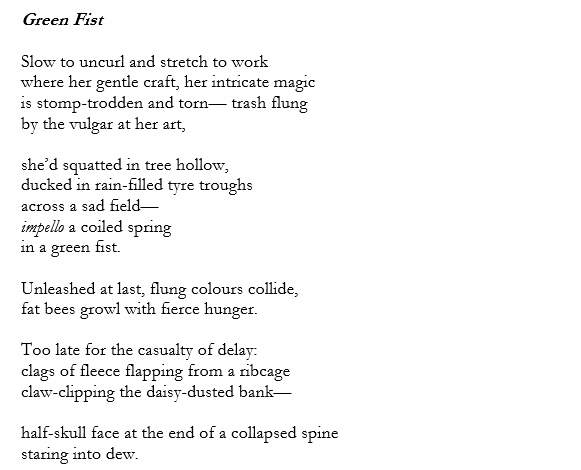
The following poem from Edges of Our Days is physical piece relating to Spring. This is Green Fist.
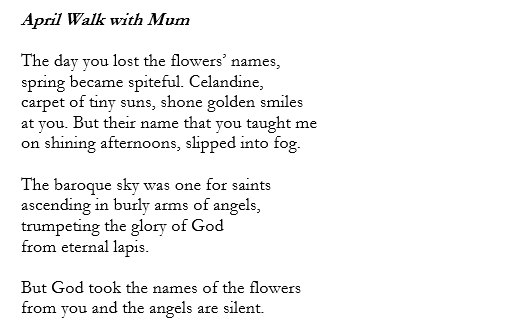
Poem four is a highly personal and heart-wrenching observation from Polly. It really resonated with me and will do with many people. I appreciate the opportunity to share this.
And finally, a reflective piece that examines emotion, disassociation and how the course of a life can change in an instant.

A big thank you to Polly for letting me share these pieces throughout the month. Full details on buying a copy can be found here.
Take it easy and make time for yourself.
Paul

